Vladimír Mužík: There are local nuances in news production, but we draw on the best practices from all CME television stations
The senior manager of the television group explains how journalism management is evolving across seven countries.
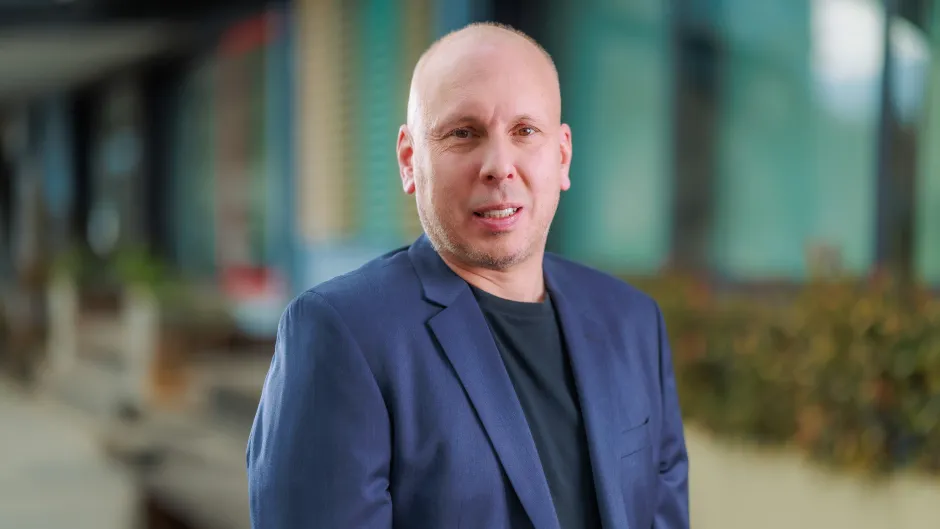
Vladimír Mužík has been working at CME for more than two years. In late February 2024, he became Director of Digital Transformation, focusing on the media group’s news content. A year and a half later, in July 2025, he took on the role of Group Head of News & Current Affairs Strategy at CME’s television stations across seven geographic markets: Czech Republic (TV Nova), Slovakia (Markíza), Romania (PRO TV), Bulgaria (bTV), Croatia (Nova TV), Slovenia (POP TV), and Moldova (PRO TV Chișinău).
Vladimír Mužík gave a special interview to the popular Czech online media outlet Médiář (mediar.cz) with journalist Ondřej Aust, in which he presented CME’s strategy for improving content quality. He discusses the exchange of expertise among the group’s news teams, coverage of sporting events across the seven markets, the direction of digital development, and CME’s presence on social media. In the interview, Vladimir also emphasizes the role of CME’s editorial board.
We present selected highlights from his interview, and the full article in its original Czech version is published on the Médiář platform: https://www.mediar.cz/vladimir-muzik-cme-pojme-sportovni-zpravodajstvi-nove/
Vladimir, what role did you take on when you joined CME a year ago? Did this position already have an established history, or was it created in response to a specific need that you continue to address today?
In part, all of this is tied to the past. The past sometimes shapes the present and the future - that’s just how things are. On the one hand, this was based on the need for CME to realize that the quality of news is not the same in all countries. I doubt it will ever be completely uniform, but it can certainly be improved.
On the other hand, someone began to take responsibility for news at the CME level, which is important for understanding the situation, comparing countries, and sharing experience. We are about 1,200 people working on content at CME. In my opinion, we are the largest team at CME, so this team needs to be supported collectively. If a country can produce an excellent program, why not use it as an example? It’s better to learn from what’s good than to come up with something of lower quality. Currently, for example, five countries are actively collaborating on the elections in Slovenia and Bulgaria. For these elections, we have mobilized the best resources available from all countries in the group.
How are these countries collaborating?
The inspiration from Slovenia was the jingle for Bulgaria, as reflected in the way the graphics are designed. Romania is helping us now with the graphics because they’re better at that. We really did provide the best resources CME has for these two election campaigns because we want to show that we can do news well. The elections in Slovenia were on March 22, and in Bulgaria on April 19.
You say 1,200 people-do you mean the entire CME or just the news staff?
I mean the news and journalism staff, that is, only those who work on content. I’m not including camera operators, editors, and other technical roles-there are many more of them, and if we counted them, the total would be around 2,000 people. However, editors and camera operators are sometimes involved with other departments, such as entertainment content, so I’m not including them in that figure.
If we look at these countries one by one in general terms, how did they differ from one another in their approach to the news, or what did you find there? It probably wasn’t the same everywhere, was it?
It will never be the same. Besides, we don’t want that either.
There are local nuances in every country, right?
You put it very well-these are local peculiarities. Every country is interested in something slightly different. For example, during the Olympics-Slovakia, the Czech Republic, and Slovenia were obsessed with the event. In Romania, however, no one was particularly interested in the Winter Olympics. In sports there, football dominates-football, football, football, then nothing, then football again… and maybe something else.
It was precisely because of these differences that we started working extensively with sports news. It turned out to be a unique challenge because everyone already knows the results. That’s why I’m now focusing on a different approach to sports, and that’s the reason I’m working in this field at the moment.
What does this new approach to sports mean? How does it manifest itself on screen or online?
Right now, I’m focused on setting up working groups. Sports have its own group, news has its own, graphic designers have theirs, and now we’re going to create an artificial intelligence group as well. The goal is to share experiences, because there are many of us and we have exceptionally talented people. I see this as one of the most important things.
We’ve also created a relatively extensive educational program called “News Masterclass.” Every month, 50 people travel to one of the countries in the group for specialized training. We want to teach people how to produce high-quality, objective, unbiased, and interesting news-and I emphasize, interesting.
Two days ago, I returned from Zagreb, where the latest Masterclass took place. There, we received information from lecturers at the Thomson Foundation on topics such as marketing and focus groups. At another masterclass, the topic is leadership; at a third, how news is produced. So, one of my main tasks is to train people. We’ve invested significant resources-there are always about 50 people from various TV stations who travel to a country within our group and participate in two-day sessions.
What do you use artificial intelligence for? I suppose it as a tool for administrative tasks, but perhaps for something else as well?
Perhaps for administrative tasks, fortunately, those don’t concern me much. But there’s one important thing: there must always be a person at the beginning, and twice as many people at the end to verify the result. This is what’s called output control, and it’s extremely important.
Usually, when we talk about AI, in the past we used it, for example, to reconstruct traffic accidents. Now this can be done much better using artificial intelligence.
This is an animated infographic, right?
Exactly. Now we can do it with real footage, but it must always be noted that the reconstruction was created using artificial intelligence. This is mandatory.
Who are the members of the CME Editorial Board?
We have three members. The chair of the board is Hans Mahr-he worked for many years in the news division at RTL in Germany and was responsible for various regions there. Next is Robby Burke, who worked in the news division at ABC and is a former director of CME. The third member is Sabine Christiansen, who has many years of experience at the public broadcaster ARD.
Do individual countries or the news directors of all countries have a say or representation, for example when something is discussed in the editorial board, or is the system designed a little differently?
It’s designed a little differently, but I’ll explain. Every six months, we hold an official meeting of the CME editorial board, where we agree on the news strategy. This is followed by what we call an editorial meeting- attended by the news directors and heads of the digital departments where everyone presents what they plan to do in each country.
The editorial board does not make decisions. Its role is to consult, advise, assist, and, if necessary, regulate. The responsibility for decision-making always remains with the individual countries and their directors. But the board is extremely useful, which is why these sessions are held every spring and every fall.
What about journalism? We know that interest in the news is enormous. I would say that journalism is even more demanding when it comes to factchecking, presenting information, and other aspects? Perhaps that is why it is expensive and challenging for television?
When I talk about journalism in individual countries, I want to give the example of Bulgaria. In Bulgaria, the day begins with journalism first thing in the morning. The morning show “This Morning” covers the main political topics-that’s journalism. This is followed by “Before Noon”-two consecutive programs lasting several hours, which also include consumer topics. This provides variety and doesn’t overload viewers with just politics.
Next comes the lunchtime news block, and later “Face to Face” airs-a face-to-face conversation with a public affairs focus. On Sundays, this segment can exceed “120 Minutes,” again featuring political discussions. The evening main news also includes a journalistic interview at the end-about 10–12 minutes long. This is how the situation looks in Bulgaria. Now I can examine another country to make it clear that approaches to journalism vary.


