Gold's New Name
Attention - the currency that measures consumer interest and brand success

For years, content creators in the media have used various techniques to attract people's attention. In business, it is no less important, as visibility stimulates associative thinking and directs the final choice of consumers. And this, in turn, brings to the fore the brands that own the most of the valuable resource called attention - the new currency for measuring consumer interest and the successful performance of brands.
According to the sales director of bTV Media Group, Dessislava Proeva, marketers are already actively focusing on the cost per unit of attention (cost per attentive seconds) and divert their attention from the traditional price per contact. "We see the practice of combining traditional metrics such as viewability, view rate and time spent with a medium to the so-called Attention per Mille (ATM) to compare the benefits of individual media.
The good news for us, the creators of premium video content, is that TV advertising is actually proving to be a much more accessible way to reach consumers than it seems at first glance, ”she said.
What is it?
Here the most natural question for all marketing professionals is "How is attention measured?" Before answering it, the bigger mystery we need to clarify is "What is attention?" It is objectively difficult to give a precise definition of subjective phenomenon and reflex of human consciousness, influenced by various stimuli - emotion, sound, movement, each of which is strictly individual.
We know that attention exists. We feel it when something really attracts and interests us, but we fail to clothe it in the material framework of our own ability to be specific. And business loves specifics. Businesses are looking for numbers and evidence for their decisions, and every brand is willing to invest in projects that will reasonably have a quantitative return on investment.
A valuable resource
It is this thought that guides marketers around the world, who have focused their efforts on measuring attention and studying the incentives that hold it back. The pioneers in the field found that the most successful research was through the study of human psychology and behavioral changes due to an image or word. By emphasizing these details, advertisers get to know their target audience more successfully and make the right decisions to reach it.
In their most up-to-date analyzes, driven by the desire to make it easier to measure results, experts discover the industry's new gold - seconds of attention, which provides a single unit of measurement for participants in the advertising process. It compares the attention generated by different media.
Each advertisement is a unique idea that aims to provoke or inspire action on the part of the end user, if it is given the appropriate attention.
What is not tangible, does not get results
Current global study by WARC (joint study of Lumen, TVIsion, Ebiquity & WARC), conducted in the period November 2020 - February 2021. in the British market, combines data from the visual focus on Facebook, Instagram, desktop advertising, mobile web formats, as well as more traditional screens such as television, with information on contact prices. Although television advertising is at first glance perceived as the most expensive in the eyes of the advertiser, in reality the actual attention generated on the screen makes it extremely accessible on the basis of a single contact and visual coverage.
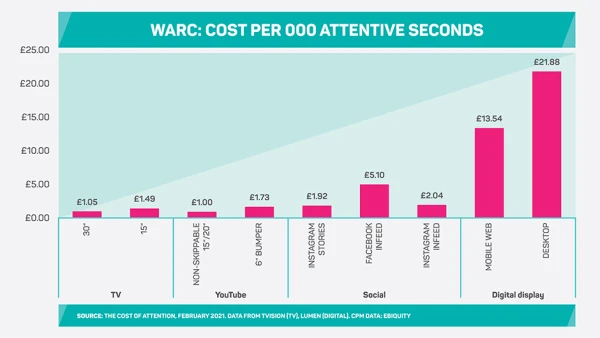
The set threshold of 2 seconds in which we can consider an ad as visible is easily achievable, but the fact that it is visible does not necessarily mean that it is seen. Nowadays, one rarely performs just one action, especially while consuming media content. Watching a movie goes hand in hand with eating, watching messages on a mobile device, and why not a phone call? We live in an age of fragmented attention, and every extra second an advertiser can get from it is an added value to their goals.
Of all the communication channels, online TV and video advertising provide enough seconds of attention and a context in which the human mind registers an idea well. The duration of 15 to 30 seconds gives the brand enough opportunity to share a story, present a plot and, accordingly, subconsciously inspire the viewer.
There is a clear relationship between viewing time and associative thinking about a brand, which gives an advantage to brands that have decided on "visibility" on television, as well as more time to share their history. The more sustained the attention, the more helpfully the mind remembers and "recalls" a brand when it finds itself in the target context.
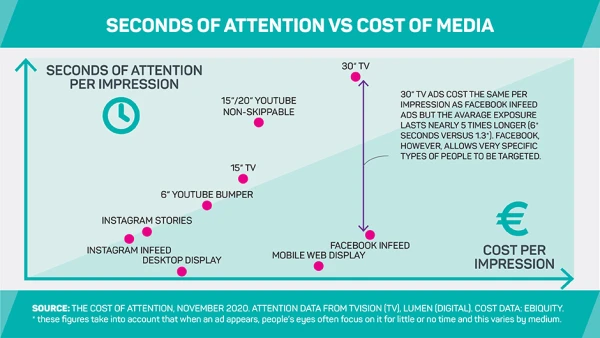
"We see how the world's industry-leading research compares the capabilities of different platforms and the results are unequivocal. Leading are the media, where brands have a full screen and strong means of expression to share their stories. They make the biggest contribution to business results. So it is with the content created by the professionals of bTV Media Group. Through the power of all our platforms, the brands reach the Bulgarians on the full screen and have the actively focused attention of our huge audience," commented Dessislava Proeva.
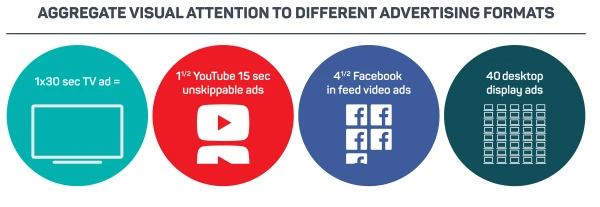
And if a TV spot sounds and seems expensive, consider the number 40 - because that's the number of all display ads needed to reach the seconds of attention generated by an impression in front of the TV screen.
The good thing is that you don't have to choose TV or web advertising, as the two work well together. And because of the high level of attention in front of the TV screen, television is the platform that gives the initial impetus to the media mix and makes a brand more noticeable. It increases the effect of placement in all other channels in an environment of scattered viewer attention.
By Konstantina Bandutova