Why Is Audio Branding Important and Effective?
And how radio adds to its communication value

Radio is a powerful platform for advertisers, which continues to have its unique advantages over other channels. Imagine a billboard ad with a picture of a burger and fries, but nothing else. Now imagine another billboard, but this time the potatoes are in a bright red box with gold arches printed on the front. You immediately start associating what you see with a well-known fast food brand. Without these visual prompts, however, advertising can be for any brand.
Now imagine a radio commercial, you hear the sound of sliced lettuce and a burger squeaking on the grill. Once again, imagine an alternative ad - this time it contains the phrase "I'm lovin it" and an instantly recognizable sound jingle*.
The use of color, logo, slogan, sound signal - all these are examples of brand assets, defined by Byron Sharp and Jenny Romanyuk of the Ehrenberg-Bass Institute as "non-brand elements that trigger the brand in the memory of the buyer category." Just like the user would find it difficult to immediately associate a billboard ad with a McDonalds without the logo and color, they will find it difficult for a radio ad without a distinctive melody or phrase.
Marketers often overlook the need to develop audio branding. A recent study by IPSOS The Power of You highlighted that although audio brand assets are 3 times more effective than visual brand assets, only 8% of ads use them (compared to 92% for visual brand assets). Audio branding is effective.
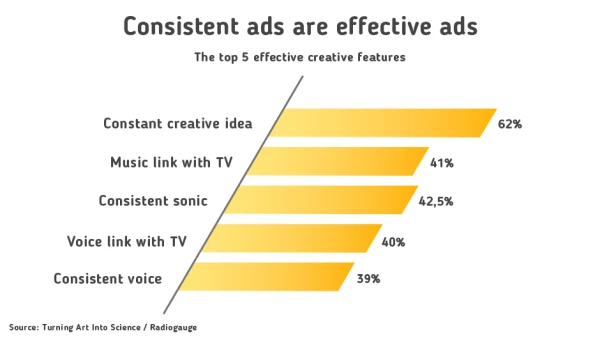
According to a study by Radiocentre, consistent ads are effective ads. Systematically, a brand's audio assets can be used in a number of forms such as spots (TV and radio), audio to pre-roll commercials in digital and radio environments, podcasts and during events, and more. In this way, brands can improve the overall effectiveness of their marketing communications in terms of recognition and perception.
* Short sound, melody or signal, used for advertising on the radio.